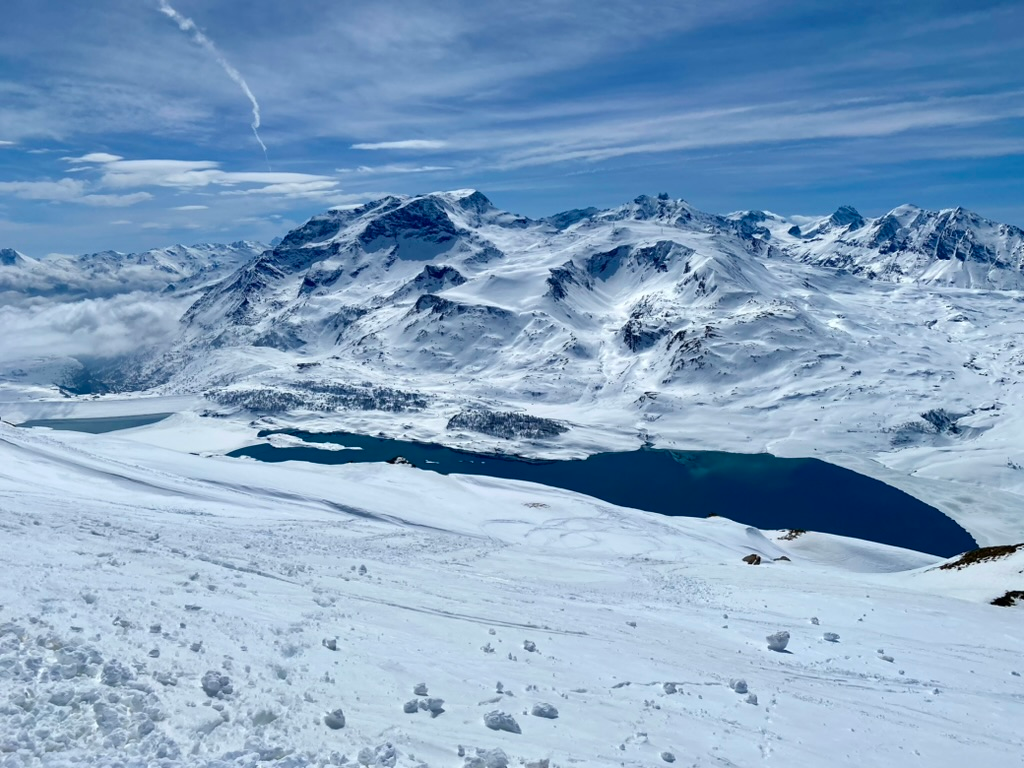
I miss the mountains when I’m in England. I miss the scale of a giant landscape that isn’t criss-crossed by lattice works of hedgerows and patches of woodland. I can enjoy a hike around Box Hill, or Leith Hill, or Holmbury Hill, or any of those little lumps that make up the Surrey Hills near us, but it isn’t quite the same. The few minutes of effort to reach the top, and a fine view to the farmland below or distant London doesn’t give me what a proper mountain might do: a view to a sea of more mountains, or to hidden lakes and valleys, or across acres of wildflowers, or to snow-covered pistes, or to buildings or villages that defy gravity as they hang to the mountainside.
It’s not the same feeling of being lost in something much bigger or grander, of realising just how small and insignificant we are against a backdrop of nature’s finest. Nor the same satisfaction of that steady upwards slog for hours rather than minutes, the slow rise in anticipation as you get closer to a summit, and then those moments of both relief and euphoria at the top, a time to soak in all around and bank memories to last a lifetime.

I miss those moments when in England; I’m deeply envious of those who can open their curtains each morning to reveal a mountain view. I dream the idealist’s dream of seeing that glow of early morning sun on snowcapped peaks, or the dark blue of a mountain lake, or the simple sensation of having a world of giants of laid out in front of me.
Yet a joy of walking is how those moments can come to you unexpectedly, the memory bank stirred for no apparent reason. There’s something about the repetition of step after step, or a moment when colours or angles or lines on a landscape trigger those happy sensations and allow you to mind-shift, and take you to somewhere you’ve been before, no matter how absurd the comparison.

Out of nowhere – a cast of the light, perhaps, or the shape of the curve of the river – a quiet river valley in the Chilterns can become Yellowstone National Park. Every roll of the gentle hills of that valley becomes a high peak of the Absaroka or Gallatin ranges that climb above the Yellowstone. For the dull skies, brown and green grass and remnants of summer’s flowers of England, I’m transported to the vibrant purples and yellows of early summer flowers in the US. For the squadron of geese facing up to a ramshackle rabble of cows grazing in the same meadow, I think of the herds of elk and bison (and the odd grizzly bear) traipsing across that giant American landscape.
Or, a few weeks later, in Hampshire, on a day that wasn’t really right for walking: a thick grey blanket smothering the sky, and the windscreen wipers on overdrive as I head to my starting point. It’s a head down and head for the woods for shelter type of walk, in the hope that things can only improve as I go along, and it’s only when I’ve stopped hoping and accepted that today is going to be wet and cold that I start to take in what’s around me.
As I emerge from the other end of the woods, I feel as though I’ve stepped into another part of the world. Steep hillsides to one side of me, with trees giving the impression of jagged rocks running along their summits, the open pasture to the other side, and a mist that takes away all sense of horizon and deeper perspective – I’m immediately in a world of alpine peaks and meadows. Even the rain feels mountain-like: it floats and dances with the wind, like snowflakes. The drops are too light to break the surface of a pond; they come to rest gently on my clothes and my face. I’m soaked through, but barely notice it.

Sometimes I wish I knew what the triggers are for those moments, so that I can take myself to a mountain world at any given time or place. Or perhaps the real joy is in not knowing what they are, the unexpected and the occasional enhancing the impact of the moment.
There’s no doubt something in my mindset at a given moment, what I’m thinking of and how I’m feeling. But more than anything, I think there’s the special quality of the English countryside itself, its relative simplicity and small scale, the little pictures or vignettes that can be captured and enlarged so that they become grander scenes from different times and different places.
It’s a process that works much harder in reverse. I don’t think I’ve ever stood in the mountains – the Alps, the Andes, or even Snowdonia – and thought: I can picture the Surrey Hills here. I can’t take those giants and turn them into something miniature. It’s probably unsurprising that the one landscape from England that I often think back to when I’m elsewhere, the tall cliffs of the the Jurassic coast, also remind me of mountains: giant stacks erupting directly from the sea, the clifftops like walking along a mountain ridge line, and panoramas that change relentlessly with the ebb and flow of the weather.

Today, I’m lucky, because I don’t have to find those triggers. I wake up and out of the window I can see snow-topped mountains; my idealist’s dream turned reality. Tomorrow, I’ll be up there, ready to enjoy my playground. Maybe when I’m there, I’ll find something to remind me of the landscape of home, but I suspect I’ll be too lost in my world to notice.