Ice, fields, rain, forest, sun and river
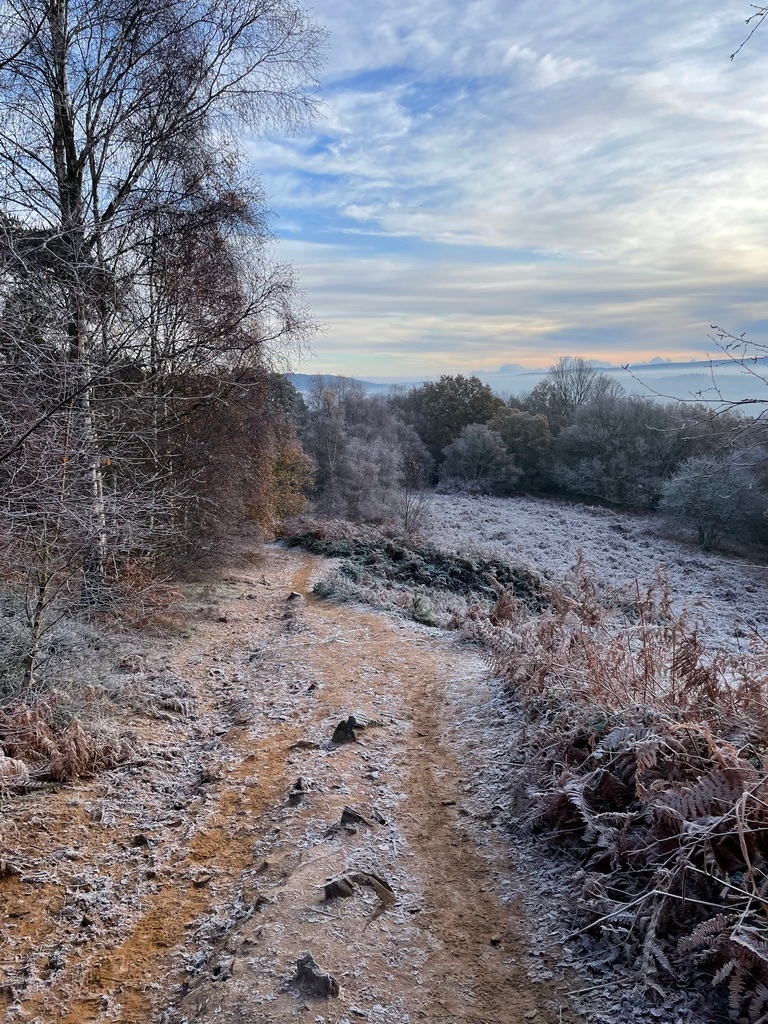
I’m walking home from school, after dropping off my son for his first day of term. Instead of the direct route home along the main road, I take a longer path that runs through semi-countryside. There’s nothing in particular to see, but at least it gives me extra time before sitting down to work, an opportunity for my mind to wander before the clutter of emails and chat to wade through.


It’s properly freezing today – -5 according to my weather app – and I can’t help but think of the contrast with family still in Colombia, some 40 degrees warmer in the heat of Girardot. But the frozen landscape also brings bigger contrasts to mind. 5 days ago I was immersed in the Amazon rainforest; the lifelessness of the fields and woodland on this detour, a literal and figurative world away from the vitality of the rainforest.
Virtual reality to real vitality
Here, I’m walking through a landscape seemingly frozen in place, not just from the cold itself but also from how still the morning is. There’s not a breath of wind to raise a flicker from the leaves or from the plastic bag caught in a hedge. Horses stand immobile in their fields, frozen like status. The track, which three weeks ago was laden with bubbling and squelching mud, is now smooth and rock solid, as if I’m walking on marble. The distant hum and throb of cars and planes and the occasional caw and chirp of birds are the only signs that I am in the real world, and not in some virtual reality.
There, the life, the sounds never stop. Morning, afternoons and nights full of birds calling: the mournful calls for a partner who seemingly never arrives; the raindrop which echoes with a high-pitched flourish; the teenage girls whose screams volley back and forth across the forest; the gentle coos. Hours of torrents of rain: hallucinations of giant waterfalls all around me. Trees and their branches and leaves shaking and rustling from the wind and from the life within.

The Amazon river itself, endlessly bringing life here and taking it away there. In this stretch, its banks are a mess of eroded mud, soil and the remains of broken trees, ready to be swept on a 2,000 mile journey to the Atlantic Ocean. We speak to communities who’ve had to rebuild houses and their precarious livelihoods because of the river’s power to snatch it all away in an instant. Its already extreme highs and lows – the river can be 11m higher at its peak in the rainy season than its lowest point in the dry season – are being exacerbated by the effects of climate change.
But that same mud and soil, and the seeds of plants and trees trapped within them, also form the basis of an ever-changing array of new islands. And of life for the local communities – the crops that grow through man’s work, but also the fruits and medicines that the forest offers up naturally.
There are other signs of life that I initially find disconcerting, the flashes of modernity and outside influence that I should have expected, but still don’t feel ‘right’. Radio towers, Christmas lights on the wooden huts dotted along the river bank, satellite dishes, cattle grazing and glimpses of tourists on horseback rides. In those early moments the river also almost feels too big for its own good. Low slung in our motorised canoe, it becomes featureless, a flat horizon of nothing but murky water and trees.
Feeling and sensing
I’m a visual person. I tend to be inspired more by what I see than what I feel or sense, and it all makes for a strangely disappointing introduction to the rainforest, a world that I’ve waited so long to experience. But in the four days that we are there, I’m turned on my head. I come to realise that the rainforest is as much about what is unseen, what is heard, what is felt and sensed, rather than what is seen.
That constant noise, instead of being an irritant, something that stops you from sleeping or wakes you too early, is somehow immensely calming, a natural white noise to feed deep sleeps and total relaxation. Learning about the innate connection local communities have with the forest: the plants they know to touch, the ones they know to ignore; the sense of an Amazonian identity rather than the Colombian or Peruvian or Brazilian titles imposed by ‘los blancos’ from outside. Those moments, particularly in that magical twilight of the early evening when the river seems just ours: our small boat cruising down the super-highway under the hot sun, kilometres of water either side, visually empty but so fulfilling – a pride in the moments we share as a family and the euphoria of having this world all to ourselves.

Forest fears
I could bathe in those small moments on the river forever, but less so in the forest itself. The woods in the UK are often a source of protection. Particularly in winter, I seek to shelter from the sweeping rain and that icy cold wind that forces its way in and clings desperately to a corner of you. Here in the Amazon, for the outsider the forest is a source of wonder and fear in equal measure.
There’s the excitement of stepping into the genuine unknown, sucked in by a seeming unending world to discover, each step, each tree swallowing you deeper. I can see why the explorers of the past, even the Spanish conquistadores, refused to turn back, could believe the stories of hidden cities of gold and other treasures. For every giant platinum blue butterfly that floats effortlessly past, or for each explosion of colour from a new plant, I want to go further, just that little bit more.
But there’s also the apprehension of being lost, trapped in a labyrinth of equally unending proportions. We don’t venture more than 500m inland from the river, but it could have been 500 miles. And as much as you marvel at the beauty around, there’s also the fear of not knowing what lies ahead; which of the giant spiders or bugs are safe and which are not; what lies unseen and unheard but tracks you and knows where you are and what you are doing at any moment. The humidity drains you, step-by-step, minute-by-minute, and I begin to crave the clear air of being on the river, away from my deep green cage.
I struggle with being shut in a place of seemingly no escape, no horizon beyond a few trees in front of you, no apparent sense of direction. As we fly in and out of Leticia before and after our visit, the extent of this world is that much more apparent. There’s an ocean of green spread below, the tops of trees like the bobbles of a carpet that goes as far as the eye can see. As much as the Amazon river is huge, the forest around is on another level.

The power to dream
As I write, snow starts to fall, and the lightest of winds flickers through the branches of a tree in my garden. The world here is showing its own signs of life. It’s a happy moment: I’m back in these familiar surroundings where I can walk freely and let my mind wander.
I try to imagine the rainforest covered in snow, the Amazon blocked by ice, and in return, the village here swallowed by trees and the local river swollen into a monster. It’s fun to play with the image: the school run by canoe, the walk to the station for my commute through a teeming forest, monkeys screaming and bugs humming. Conversely, the wonder on the faces of the communities in the Amazon at the strange touch and look and bitter cold of the snow and ice.
I’m reminded of a book I recently bought for my goddaughter: You Only Live Once. Travel opens the mind and gives us the power to dream. This corner of Surrey will never be the Amazon, but the pictures I have now will (hopefully) never fade. They allow me to warm up this cold morning. Same seat, same desk, but new horizons.